I. Introduction
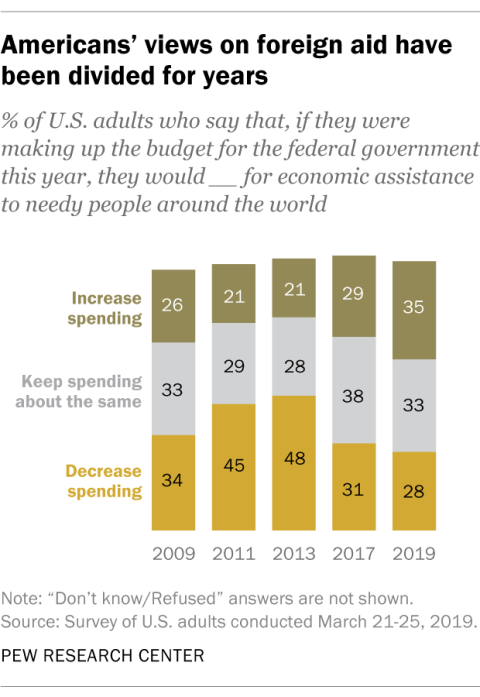
One of the most controversial debates in American politics is foreign aid spending. In 2025, the Pew Research Center conducted a study showing that Americans' views on foreign aid have remained divided since 2009. In 2019, 35% of U.S. adults wanted to increase spending on aid, while 33% wanted to keep it the same, and 28% wanted to decrease it. One reason for this lack of national agreement is misconceptions about foreign aid, which often stem from insufficient education on the topic.1 In 2023, the U.S. government spent $71.9 billion, or 1.2% of its total budget, on aid to countries abroad, yet polls consistently show that Americans believe it accounts for 25% of the federal budget.2
II. Misconceptions
Americans typically overestimate the proportion of the budget allocated to foreign aid, yet even after learning the true figure, many still favor budget cuts. American opposition to foreign aid, especially in right-wing groups, stems from ideological factors and core values, not just misinformation.3 Media horror stories concerning systematic failures in Afghanistan and Iraq sparked anti-interventionist movements and changed the sentiment on foreign aid. At the same time, politicians constantly use rhetorical phrases like "funding for global health programs," "disaster relief," or "food aid for starving children" that encourage moral support for foreign aid.
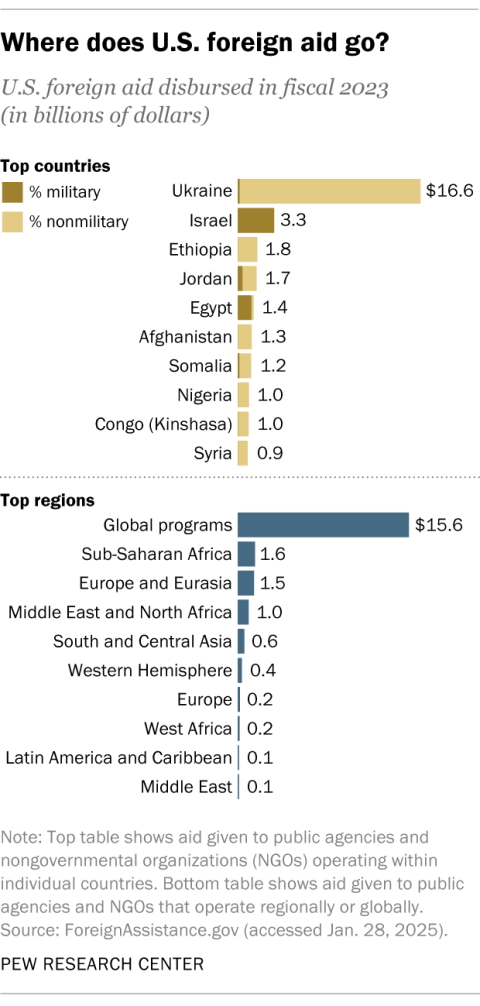
In the media, foreign aid is lumped together, but distinguishing humanitarian aid from military reconstruction aid is crucial. While military reconstruction aid is costlier and tends to perform worse than humanitarian aid, it is essential to U.S. interests. In Iraq, Afghanistan, and Ukraine, the stakes are high, but the task is demanding and resource-intensive. Americans often generalize their beliefs about failures in military aid to much simpler humanitarian funding of global health initiatives and sustainable development programs.
III. Political Polarization
This public discourse polarizes Americans' views on the topic. Foreign aid programs are presented as noble pursuits. Yet most Americans aren't aware of their complexity and often fail to weigh the positive and negative outcomes of investment abroad, leading to mixed opinions. This isn't just a result of bad judgment; even experts struggle to evaluate foreign aid programs. Their outcomes are complex: short-term successes may not hold up in the long term, and foreign aid can unexpectedly support corruption and create dependency. While a program may fail economically, it may still achieve secondary goals, such as increasing U.S. soft power in the area. It is difficult to judge a foreign aid program until long-term effects become apparent.
IV. The Failures
In recent years, foreign aid has produced mixed results: between 2017 and 2019, 43% of USAID awards failed to achieve half of their intended results, yet the implementing parties were still paid in full almost every time.4 Humanitarian aid is often undermined by structural weaknesses, for example, the problem of "Beltway Bandits." USAID awards these middleman organizations large contracts, which incentivize them to spend money rather than necessarily produce results. Research has shown that failures in foreign aid can be attributed to a problematic system that makes achieving moral goals more difficult.
These structural issues go beyond humanitarian aid, military reconstruction, and economic reconstruction. In Afghanistan, officials struggled to implement a coherent strategy and underestimated the scale of rebuilding the country. Infrastructure projects were not sustainable, and there was insufficient monitoring and evaluation. SIGAR revealed that reconstruction may have been impossible even if it was implemented properly, suggesting that the U.S. should never have committed to being in Afghanistan.5
In Iraq, the U.S. again failed to implement a successful economic aid program. Challenged by insecurity and violence, weak public services, and De-Ba'athification policies, which purged the country of skilled workers and undermined the need for cheap labor, Iraq's reconstruction failed.6 In both cases, aid failed to prevent significant humanitarian crises, notably in Afghanistan, where only 2% of the population has enough food due to oppressive Taliban policies.7
As seen in Iraq and Afghanistan, economic reconstruction programs are often slippery slopes that yield lackluster results. Coupled with data showing that post-2010 humanitarian aid also underperformed its goals, this suggests that the whole system has long grappled with inefficiencies and incompetence. U.S. foreign aid programs tend to incentivize activity rather than outcomes, pursue short-term, unsustainable goals, and lack coordination across departments.8
V. The Successes
On the other hand, many USAID programs have led to positive change in other countries; notably, humanitarian and health aid have been the most successful in achieving their goals. The $4.5 billion contributed to the Global Polio Eradication Initiative over the last 35 years has prevented an estimated 2.4 million paralytic cases. There is also an indirect impact on child mortality rates and life expectancy in developing countries receiving aid. In total, the estimated number of lives saved per year by U.S. aid ranges between 2.3 million and 5.6 million.9 It must be noted that these development programs often face setbacks, as with military and economic reconstruction aid. USAID funded the installation of computer kiosks in rural Indian villages that fell into disuse. Water projects in Africa have failed due to poor maintenance and insufficient spare parts.
Conclusion
Foreign aid is neither a straightforward moral good, as advocates suggest, nor a complete budget-draining failure, as critics claim. Americans' divided opinions on the subject reflect both a lack of proper information surrounding the topic and a deeper struggle to understand a complex foreign policy issue. The misconception that foreign aid accounts for 25% of the U.S. budget distorts the public debate, but it doesn't resolve the ideological disagreements that drive divisiveness. The real system consists of many successes; U.S. humanitarian aid has eradicated polio and saved millions of lives through the WHO, and military aid in Bosnia and Herzegovina achieved its goals in cooperation with NATO. Yet the modern foreign aid complex faces structural hurdles that limit its effectiveness. Americans who support budget cuts should rather focus on passing legislation that ensures competent bureaucracy, long-term planning, and interdepartmental cooperation.
The failures of Iraq and Afghanistan show how foreign aid is a slippery slope that can lead to overspending and wasted budget. Foreign aid is not morally invincible because it can exacerbate sectarian violence and humanitarian crises inadvertently. However, these case studies should not be generalized to all military reconstruction programs and humanitarian aid. The problem is not the scale of U.S. investment abroad, but the system's desperate need for reform. We should adopt a more accountable, outcome-focused approach to foreign aid and provide quality education to better inform Americans. Until Americans better understand the costs, challenges, and potential benefits of foreign aid, the debate will remain influenced by misconceptions and political rhetoric that don't do justice to its true complexity.
Bibliography
- Drew Desilver, "What the Data Says about U.S. Foreign Aid," Pew Research Center, February 6, 2025, https://www.pewresearch.org/short-reads/2025/02/06/what-the-data-says-about-us-foreign-aid/.
- "Debate: American Foreign Aid," GovFacts, accessed May 2026, https://govfacts.org/debate-american-foreign-aid/.
- "Debate: American Foreign Aid."
- "Debate: American Foreign Aid."
- Special Inspector General for Afghanistan Reconstruction, What We Need to Learn: Lessons from Twenty Years of Afghanistan Reconstruction, SIGAR 21-46-LL (Washington, D.C.: SIGAR, August 2021).
- "Iraq Trip Report," Center for Strategic and International Studies, accessed May 2026.
- "A Look at Afghanistan's Humanitarian Crisis," Council on Foreign Relations, accessed May 2026, https://www.cfr.org/backgrounder/afghanistan-humanitarian-crisis.
- James Dobbins et al., After the War: Nation-Building from FDR to George W. Bush (Santa Monica: RAND Corporation, 2008), https://www.rand.org/pubs/monographs/MG716.html.
- Amanda Glassman, "How Many Lives Does US Foreign Aid Save?" Center for Global Development, February 19, 2019, https://www.cgdev.org/blog/how-many-lives-does-us-foreign-aid-save.